
| Nucleic acid, DNA Structure, RNA, Transcription and Translation | |
|
Nucleic acid, DNA Structure, RNA, Transcription and Translation |
| DNA: |
|
|
Nucleic acid, DNA Structure, RNA, Transcription and Translation, DNA and its close relative RNA are perhaps the most important molecules in biology. They contains the instructions that make every single living organism on the planet. DNA stands for deoxyribonucleic acid and RNA for ribonucleic acid. They are polymers (long chain molecules) made from nucleotides. |
|
| Nucleotides |  |
|
Nucleotides have three parts to them: |
 |
| The Bases: | |
| Adenine (A), Thymine (T), Cytosine (C), Guanine (G) and Uracil (U) | |
| Nucleotide Polymerisation: | |
|
|
Nucleotides polymerise by forming bonds between the carbon of the sugar and an oxygen atom of the phosphate. The bases do not take part in the polymerisation, so the chain is held together by a sugar-phosphate backbone with the bases extending off it. This means that the nucleotides can join together in any order along the chain. Many nucleotides form a polynucleotide. A polynucleotide has a free phosphate group at one end and a free OH group at the other end.
|
| Structure of DNA: | |
|
The main features of the three-dimensional structure of DNA are: |
|
|
|
|
|
|


|
Function of DNA |
|
|
DNA is the genetic material, and genes are made of DNA. DNA therefore has two essential functions: replication and expression. |
|
|
|
|
|
|
|
Expression can be split into two parts: transcription (making RNA) and translation (making proteins). These two functions are shown in this diagram. |
|
|
|
|
| No one knows exactly how many genes we humans have to control all our characteristics, the latest estimates are 60-80,000. The sum total of all the genes in an organism is called the genome. | |


| Genes only seem to comprise about 2% of the DNA in a cell. The majority of the DNA does not form genes and doesn’t seem to do anything. The purpose of this junk DNA remains a mystery! |
| RNA | |
|
RNA is a nucleic acid like DNA, but with 4 differences: |
|
|
|
|
Messenger RNA (mRNA) |
|
|
mRNA carries the “message” that codes for a particular protein from the nucleus (where DNA is) to the cytoplasm (where proteins are synthesised). It is single stranded and just long enough to contain one gene only. |
|
|
Ribosomal RNA (rRNA) |
|
|
A structural molecule part of ribosomes – details are not required |
|
| Transfer RNA (tRNA) | |
|
|
|

|
The Genetic Code |
|
|
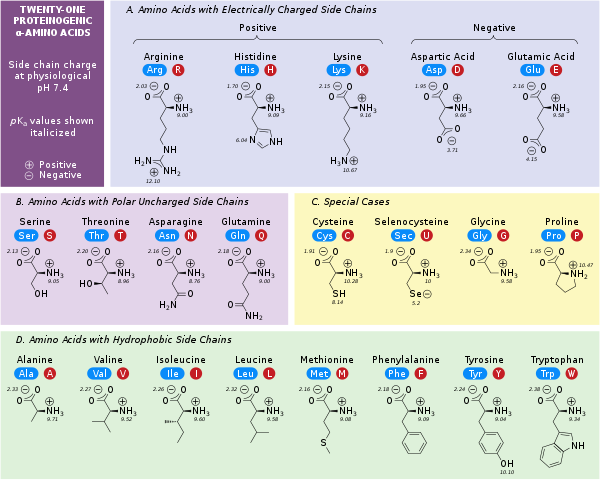
The sequence of bases on DNA codes for the sequence of amino acids in proteins. But there are 20 different amino acids and only 4 different bases, so the bases are read in groups of 3. This gives 64 combinations, more than enough to code for 20 amino acids. A group of three bases coding for an amino acid is called a codon, and the meaning of each of the 64 codons is called the genetic code. |
|
|
|
|
|
There are several interesting points from this code (which by the wat you do not need to know): |
|
|
|

| Replication – DNA Synthesis | |
| DNA is copied, or replicated, before every cell division, so that one identical copy can go to each daughter cell. The double helix unzips and two new strands are built up by complementary base-pairing onto the two old strands. | |
|
|
|
|
|
|
The Meselson-Stahl Experiment |
|
| This replication mechanism is sometimes called semi-conservative replication, because each new DNA molecule contains one new strand and one old strand. There was an alternative theory which suggested that a “photocopy” of the original DNA was made, leaving the original DNA conserved (conservative replication). The proof that the semi-conservative method was the correct method came from an experiment performed by Meselson and Stahl using the bacterium E. coli together with the technique of density gradient centrifugation, which separates molecules on the basis of their density. | |
|
|
|


| Transcription – RNA Synthesis |  |
|
DNA never leaves the nucleus, but proteins are synthesised in the cytoplasm, so a copy of each gene is made to carry the “code” from the nucleus to the cytoplasm. This copy is mRNA, and the process of copying is called transcription. |
|
|
|
|
|
|

|
Translation – Protein Synthesis |
|
|
1. A ribosome attaches to the mRNA at an initiation codon (AUG). The ribosome encloses two codons.
|
|
|
2. met-tRNA diffuses to the ribosome and attaches to the mRNA initiation codon by complementary base pairing.
|
|
|
3. The next amino acid-tRNA attaches to the adjacent mRNA codon (leu in this case).
|
|
|
4. The bond between the amino acid and the tRNA is cut and a peptide bond is formed between the two amino acids.
|
|
|
5. The ribosome moves along one codon so that a new amino acid-tRNA can attach. The free tRNA molecule leaves to collect another amino acid. The cycle repeats from step 3.
|
|
|
6. The polypeptide chain elongates one amino acid at a time, and peels away from the ribosome, folding up into a protein as it goes. This continues for hundreds of amino acids until a stop codon is reached.
|
|


|
A single piece of mRNA can be translated by many ribosomes simultaneously. A group of ribosomes all attached to one piece of mRNA is called a polysome. |
|
|

|
Post-Translational Modification |
|
| In eukaryotes, proteins often need to be altered before they become fully functional. Modifications are carried out by other enzymes and include: chain cutting, adding sugars (to make glycoproteins) or lipids (to make lipoproteins). These changes occur in the Golgi Apparatus | |
|
Mutations |
|
|
Mutations are changes in genes, which are passed on to daughter cells. DNA is a very stable molecule, and it doesn’t suddenly change without reason, but bases can change when DNA is being replicated. Normally replication is extremely accurate but very occasionally mistakes do occur (such as a T-C base pair). Changes in DNA can lead to changes in cell function like this: |
|
|
|
|
|
There are basically three kinds of gene mutation, shown in this diagram: |
|
|
|
|
|
The actual effect of a single mutation depends on many factors: |
|
|
|
|
As a result of a mutation there are three possible phenotypic effects: |
|
|
|
|
These kinds of mutation are called point or gene mutations because they affect specific points within a gene. There are other kinds of mutation that can affect many genes at once or even whole chromosomes. These chromosome mutations can arise due to mistakes in cell division. A well-known example is Down syndrome (trisonomy 21) where there are three copies of chromosome 21 instead of the normal two. |
|
|
Mutation Rates and Mutagens |
|
|
Mutations are normally very rare, which is why members of a species all look alike and can interbreed. However the rate of mutations is increased by chemicals or by radiation. These are called mutagenic agents or mutagens, and include: |
|
|
|


|
DNA and Chromosomes |
|
| The DNA molecule in a single human cell is about 1m long so in order to fit into the cell the DNA is cut into shorter lengths and each length is tightly wrapped up with histone proteins to form a complex called chromatin. During most of the life of a cell the chromatin is dispersed throughout the nucleus and cannot be seen with a light microscope. | |
| Just before cell division the DNA is replicated so there is temporarily twice the normal amount DNA. Following replication the chromatin then coils up even tighter to form short fat bundles called chromosomes. These are about 100 000 times shorter than fully stretched DNA and are thick enough to be seen under the microscope. Each chromosome is roughly X-shaped because it contains two replicated copies of the DNA. The two arms of the X are therefore identical. They are called chromatids, and are joined at the centromere. (Do not confuse the two chromatids with the two strands of DNA.) The complex folding of DNA into chromosomes is shown below. | |
|
|
micrograph of a single chromosome |
|
|
| Since the DNA molecule extends from one end of a chromosome to the other, and the genes are distributed along the DNA, then each gene has a defined position on a chromosome. This position is called the locus of the gene. | |


|
Karyotypes and Homologous Chromosomes |
|
|
If a dividing cell is stained with a special fluorescent dye and examined under a microscope during cell division, the individual chromosomes can be distinguished. They can then be photographed and studied. This is a difficult and skilled procedure, and it often helps if the chromosomes are cut out and arranged in order of size. |
|
|
|
|
|
This display is called a karyotype, and it shows several features: |
|
|
|
| Nucleic acid, DNA Structure, RNA, Transcription and Translation, Nucleic acid, DNA Structure, RNA, Transcription and Translation, Nucleic acid, DNA Structure, RNA, Transcription and Translation, Nucleic acid, DNA Structure, RNA, Transcription and Translation | |

Nucleic acid, DNA Structure, RNA, Transcription and Translation, Nucleic acid, DNA Structure, RNA, Transcription and Translation,