
Gaseous Exchange In Organisms
Surface Area to Volume Ratio
Gaseous Exchange In Organisms, Surface area: volume ratio crops up in many exam questions. They can be questions relating to trees, plants, fish or mammals. The question will be about the size/shape of the particular organism or how its size/shape is adapted to its usually adverse surroundings.
Exchange In Organisms
A small organism, like an amoeba, has a large surface area: volume ratio and so it can take all the oxygen it needs by diffusion across the body surface. However, a large organism, like a mammal, has a much smaller surface area: volume ratio, so it cannot get all the oxygen it needs in this way. (A large surface area: volume ratio is preferable for carrying out exchange of substances). Such large organisms need special respiratory organs such as lungs for taking in oxygen.
Examples
- Alveoli in the lungs have a large surface area: volume ratio meaning gas exchange in humans occurs at a fast rate.
- The filaments used in gas exchange for fish also have a large surface area: volume ratio as its surfaces are covered in lamellae. This larger ratio means it is suitable for diffusion.
- The leaves of plants have a large ratio meaning again exchange is carried out more effectively.
Heat and water loss
Heat/water loss is affected by surface area: volume. In large organisms heat/water loss is less than in small organisms. This is because the organism has longer pathways and longer distances, probably more insulation so it is harder for the heat to escape. Conversely, in smaller organisms heat/water loss is greater than in large organisms. The organism has much shorter pathways; all its internal organs are closer to the surface and have less insulation.
Calculating the ratio
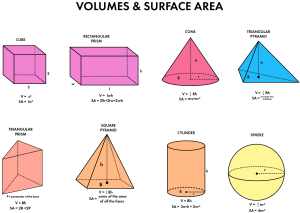
- Look at surface area and volume
- Check they are in the same units
- Divide the larger one by the smaller one= ANSWER
- The answer: 1is the ratio, where the answer is the figure for the larger volume
Large Mammals have difficulties regulating body temperature in hot climates due to:
- Small Surface Area to Volume Ratio
- Less heat is lost to the environment
- Homeotherms – Generate heat by metabolic processes
Blood vessels near the surface of the skin help to regulate body temperature by:
- Cooling the body from the core of the body
- More heat is lost due to Radiation
- More heat is lost due to Convection
- More heat is lost due to Conduction
- More heat is lost due to sweating
- Air flow over surface can be increased
The importance of a larger body size and mass to mammals in colder climates are:
- They have a small surface area to volume ratio
- They are homiothermic
- Lose less heat to the environment
- They have Fat for Insulation
- Lose less heat by Radiation/Conduction/Convection
Fish Gas Exchange
Structure of Respiratory Surfaces
- Gills provide a large Surface Area, mainly given by the filaments and secondary lamellae.
- The gills are highly capillarised which gives a good blood supply.
- Gills have a short diffusion distance; this is provided by flattened cells in capillaries and epithelium (surface of gill plates). This enables 02 to get into the bloodstream faster.
- In the respiratory system of a fish there is a countercurrent, this increases the efficiency of gas exchange. The blood flows in the opposite direction to water, this helps to maintain a diffusion gradient right along the gill. A result of this more 02 can diffuse from the water to the blood.
Fish Ventilation
- Fish ventilate using unidirectional respiration – this is due to the density of water being too great for the fish to breathe tidally as humans.
- The fish firstly expands its Buccal Cavity creating a large surface area for the intake of water.
- Pressure decreases in the buccal cavity lower than that of the external atmospheric pressure and water enters down a pressure gradient.
- As the fish closes it’s mouth it raises the floor of the buccal cavity, decreasing volume, increasing pressure.
- Water is forced over the gills.
- At the same time the Opperculum cavity bulges out, decreasing the pressure within the cavity – water is drained over the gills.
- Removal of carbon dioxide occurs as the blood containing high concentrations of the waste gas goes to the gills and diffuses out into the water down a diffusion gradient (external water has lower concentrations of carbon dioxide than levels in the blood –sets up a diffusion gradient.)
Ventilation in Mammals
Very small organisms such as those consisting of a single cell, have no special tissues, organs or systems for gaseous exchange. Mammals are large, multi cellular organisms and they have a complex system for gaseous exchange. Mammals needs such a system single celled organism does not.
|
|
Breathing In:
- Diaphragm contracts and flattens.
- Intercostal muscles contract, therefore ribs move up and out.
- The volume of the thorax increases, decreasing pressure below atmospheric pressure.
- Oxygen flows into large air passages i.e Trachea => Bronchi => largest Bronchioles
- Final pathway – oxygen diffuses into alveoli along the concentration gradient. In the alveoli, oxygen dissolves into a film of liquid, which then diffuses the short distance into the blood capillaries.